Can foreigners still buy property in Spain?
Yes. At the time of writing (October 2026), Spain places no general restriction on foreigners buying property, and you do not need to live in Spain to own a home there. The one exception is rural land in some sensitive areas, such as the Balearic Islands and the south of the Costa Blanca, where buyers who are not citizens of an EU country need a military permit.
The general position
Buyers from EU countries and from outside the EU can buy on the same terms, and EU citizens buy on the same terms as Spaniards. What you do need is an NIE, the foreigner's identity number, because you cannot sign the purchase deed, open a bank account or pay your taxes without it.
Being resident only makes a difference in two areas: some tax reliefs that are reserved for residents, and how long you are allowed to stay.
The military permit for rural land
A 1975 law on areas of interest for national defence treats certain parts of Spain as sensitive. Buyers who are not citizens of an EU country, including British, Swiss and Norwegian buyers, need prior authorisation from the Ministry of Defence to buy rural land there. It is not normally required for flats, town houses and villas on urban land. Two areas matter most to readers of these guides:
- The Balearic Islands, where all Spanish islands count as sensitive. Within each municipality no more than 15% of the land may be in foreign hands, and applications can be refused where that cap is reached.
- The south of the Costa Blanca: Torrevieja, Orihuela (including Orihuela Costa), Pilar de la Horadada and San Miguel de Salinas. Since July 2021 the Ministry has only required the permit there for rural land, not for homes on urban land, although this rests on an internal instruction, so your lawyer should confirm it for the specific plot.
The permit also applies to a Spanish company if non-EU owners hold more than half of it or control it. Without it, the notary cannot authorise the sale and it cannot be registered in your name. If you are looking at a country property in one of these areas, your lawyer should apply once you have a reservation, and the private contract should depend on the permit being granted, which can take several months.
The proposed 100% tax
In January 2025 the Spanish government proposed a new tax of up to 100% of the price on homes bought by non-residents from outside the EU. At the time of writing it has not been debated in Congress, does not have a majority there and is not law. As drafted, it would not have covered new homes bought from a developer.
Regional proposals and EU rules
A bill to restrict second-home purchases by non-residents in the Balearics was rejected by the Balearic Parliament in early 2026, and the regional government has said it would look at restrictions only if EU law allowed them. An EU Affordable Housing Act proposed in September 2026, which is not yet law, would allow limits on second-home purchases only in areas of proven housing stress, under strict conditions and without discriminating between EU nationals. On the Costa Blanca, what has changed is not who may buy but what owners may do: several towns have stopped or limited new holiday lets. This remains a live political question, so check the position again when you are ready to buy.
Owning a home is not the right to live in it
Immigration law and property law are separate. Until you hold a Spanish residence permit, an owner from outside the EU, Norway and Switzerland, including a British one, may spend no more than 90 days in any rolling 180-day period in the Schengen area. Owning a home does not extend this, and days in other Schengen countries count towards it.
Since April 2026, after a roll-out that began in October 2025, the rule has been enforced electronically through the EU's Entry/Exit System, which records your face and fingerprints on first entry and logs every entry and exit. ETIAS, an online travel authorisation, is expected later; the EU will announce the start date several months in advance. Overstaying can lead to fines and a ban on re-entry.
Buying no longer leads to residence either. The golden visa, which offered residence to non-EU buyers spending €500,000 or more, was closed to new applications from 3 April 2025. To spend more than three months of each half-year in Spain, you need a residence permit, usually the non-lucrative visa. EU, EEA and Swiss citizens simply register with the Central Register of Foreigners if they stay more than three months.
Mortgages for non-residents
Spanish banks lend to foreign buyers, but they lend non-residents a smaller share of the value than residents. These figures are each bank's own policy, not set by law, and they change with the market and with your profile.
| Your situation | Typical maximum loan |
|---|---|
| Resident in Spain (including foreigners) | Up to 80% |
| Non-resident living in the EU | 60% to 70% |
| Non-resident living outside the EU | 50% to 60% |
The percentage is applied to the lower of the agreed price and the bank's valuation, so a low valuation shrinks the loan. Banks also tend to want your total monthly debt payments, the new mortgage included, below 30% to 35% of your net income. Terms for non-residents are usually 20 to 25 years.
Once purchase costs are added, plan to fund 40% to 50% of the price from your own money. The free calculators for the Balearic Islands and the Costa Blanca can help you work out the total.
Spain's 2019 mortgage law protects non-residents in the same way as residents. The bank pays almost all the set-up costs, while you pay for the valuation. It must give you the standard European information sheet (FEIN), and at least ten calendar days must pass before you sign, during which the notary explains the terms to you free of charge.
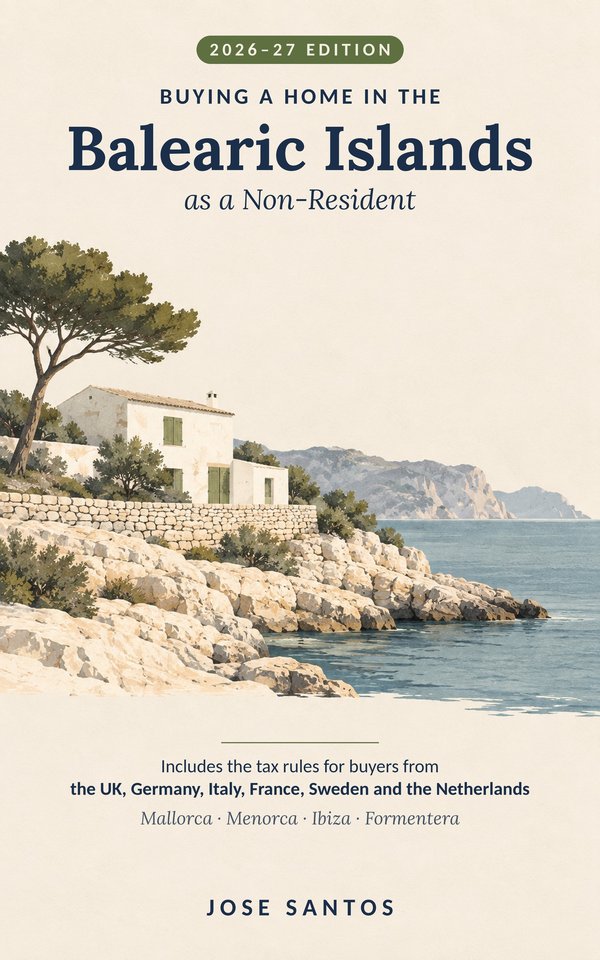
More detail in the book. Chapters 1, 3, 7 and 12 of Buying a Home in the Balearic Islands as a Non-Resident cover this with worked examples, deadlines and the risks behind the figures.
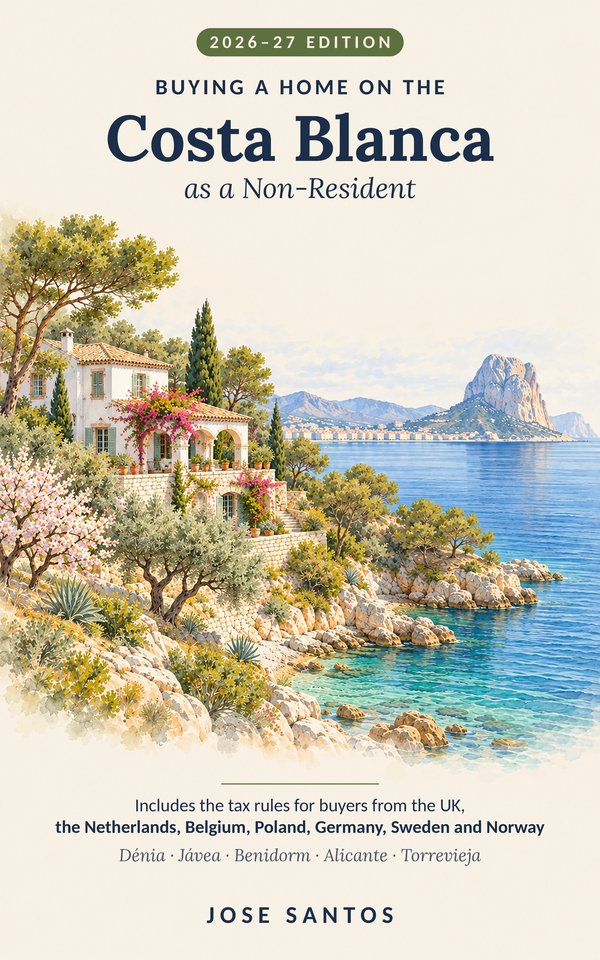
More detail in the book. Chapters 1, 3, 7 and 12 of Buying a Home on the Costa Blanca as a Non-Resident cover this with worked examples, deadlines and the risks behind the figures.
General information based on the rules in force in October 2026, not legal or tax advice. Rules change often: check your own case with an independent Spanish lawyer or tax adviser before you act.
Related: How much does it cost to buy a home in the Balearic Islands? · How much does it cost to buy a home on the Costa Blanca?