Dénia · Jávea · Calpe · Benidorm · Alicante · Torrevieja · 2026–27 edition
Buying a Home on the Costa Blanca as a Non-Resident
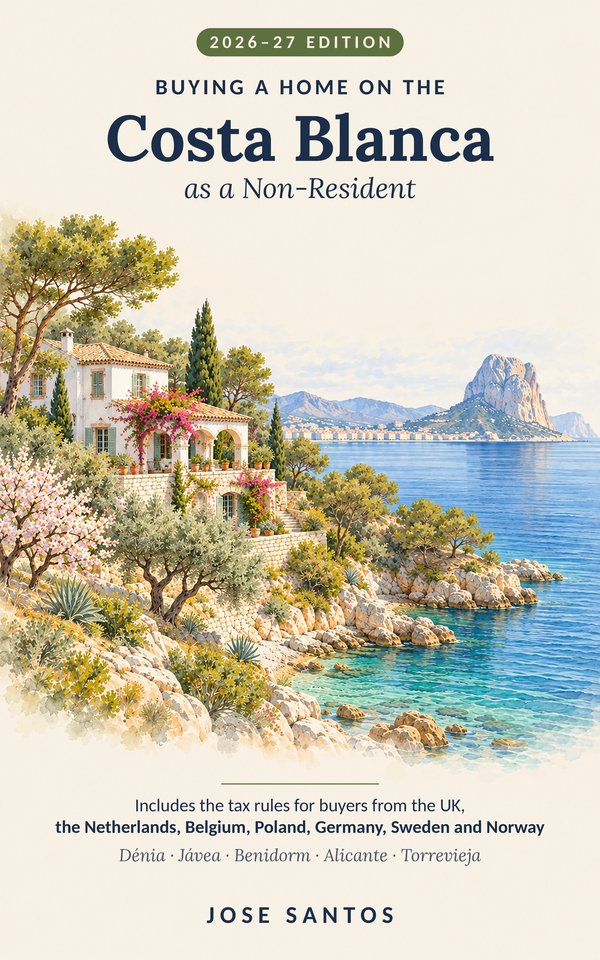
A practical guide for buyers who live outside Spain. It follows a home through its life, from buying and owning to letting, selling and leaving it to your children, and answers the questions buyers from abroad ask at each step.
- Rules in force in 2026–27
- Worked examples with real figures
- How seven home countries tax the same house
- Paperback and Kindle
It answers questions such as
- Can I buy as a foreigner?And what you need before you start looking: NIE, bank account, power of attorney.
- What does buying cost on top of the price?The 9% transfer tax and the €1 million step, VAT and stamp duty on new builds, fees and the Catastro reference value.
- How does the process work, from offer to keys?Reservation, deposit, private contract, the notary, and the military permit some non-EU buyers need in the south.
- What should my lawyer check before I sign?Unlicensed building on rural land, development charges, developments never handed over, flood risk.
- What work can I do on the house?Which licences or declarations you need, and what the work costs in tax.
- Can I let the home to holidaymakers?The Valencian registration, the town hall report, the towns that have stopped new lets, and how rent is taxed.
- What do I pay each year as a non-resident?Non-resident income tax, IBI and wealth tax.
- What happens when I sell?Tax on the gain and how to recover the 3% your buyer withholds.
- What if I leave it to my children?The Valencian 99% reduction, the new reliefs for brothers, sisters, nephews and nieces, and wills.
- How does my own country tax the home?The UK, the Netherlands, Belgium, Poland, Germany, Sweden and Norway.
What makes it different
Figures you can check
Every rate and threshold comes from official Spanish sources where possible, and the book says when a figure is an estimate or a market practice rather than a rule.
Worked examples
Most chapters follow the same €450,000 villa through the numbers, and four case studies follow typical owners from the first offer to the question of who inherits.
Your country as well as Spain
Spanish tax is only half the story. A country annex explains how seven home countries tax the same house, so a Spanish saving is not undone at home.
Inside the book
- 1. Before You StartNIE, bank account, power of attorney, and whether you need a tax representative.
- 2. Choosing Your AreaThe coast from Dénia to Pilar de la Horadada, Alicante city and the countryside inland.
- 3. The Buying Process, Step by StepFrom the offer to the notary, the military permit in the south, whose name to buy in, off-plan purchases.
- 4. The Legal ChecksLand Registry, licences, rural land, development charges, flood maps and debts that come with the house.
- 5. Renovating and Building WorkWhich work needs which licence, and what it costs in tax.
- 6. What Buying Really CostsTransfer tax, VAT, stamp duty, the reference value and fees.
- 7. Financing Your PurchaseMortgages for non-residents and what banks lend.
- 8. The Yearly Cost of OwningNon-resident income tax, IBI, wealth tax and the forms to file.
- 9. Renting Out Your HomeRegistration, town restrictions, guest registration and tax on rent.
- 10. Selling Your HomeTax on the gain, the 3% withholding and the municipal plusvalía.
- 11. Leaving Your Home to Your ChildrenValencian inheritance and gift tax, wills and the EU rules.
- 12. Making the Move: Becoming ResidentWhat changes, in tax and paperwork, if you move to Spain.
- 13. Country Annex: Your Taxes at HomeThe UK, the Netherlands, Belgium, Poland, Germany, Sweden and Norway.
- 14. Four Owners, Start to FinishFour case studies from the first offer to who inherits.
Plus: scenarios compared side by side, a directory of official sources, and a glossary of Spanish terms.
Try the numbers on your own home
The free calculator that goes with the book estimates the Spanish taxes on buying, owning, letting, selling and inheriting, plus what your own country may add. It runs in your browser and needs no sign-up.
The book's example: a €450,000 resale villa
Owner resident in the Netherlands, rules in force in October 2026.
Keep your figures up to date
Get the calculator as a spreadsheet and a short email when Spanish or Valencian rules change. No more than a few emails a year.
Free guides
Short answers to the questions buyers ask most. The book goes into each one in more depth.
- How much does it cost to buy a home on the Costa Blanca?
- Getting an NIE to buy property in Spain from abroad
- Can foreigners still buy property in Spain?
- Legal checks before buying a villa or country house on the Costa Blanca
- What does a non-resident pay each year on a Costa Blanca home?
- Can I let my Costa Blanca home to holidaymakers?
- Selling a Costa Blanca home as a non-resident
- Inheritance tax on a Costa Blanca home when you live abroad
Questions
How up to date is it?
The 2026–27 edition reflects the rules in force in October 2026, including the Valencian transfer tax cut to 9% from June 2026, the new inheritance tax reliefs for brothers, sisters, nephews and nieces, and the latest town rules on holiday lets. Spanish and Valencian rules change often, so each edition is updated, and the book flags the points most likely to change.
I don't live in one of the seven countries in the annex. Is it still useful?
Yes. Everything except the country annex applies to any non-resident buyer. The annex covers the United Kingdom, the Netherlands, Belgium, Poland, Germany, Sweden and Norway; for other countries, the book tells you what to ask a local adviser.
Does it cover the whole Costa Blanca?
Yes: the province of Alicante, from Dénia and Jávea in the north, through Calpe, Altea, Benidorm and Alicante city, to Torrevieja, Orihuela Costa and Pilar de la Horadada in the south, and the countryside inland.
Is it legal or tax advice?
No. It is general information to help you understand the process and the numbers, and to ask the right questions. Before you sign anything, take advice from an independent Spanish lawyer and, where relevant, a tax adviser in your own country.
Paperback or Kindle?
Both have the same content. The paperback is 6 × 9 inches; the Kindle edition works on any Kindle device or the free Kindle app.
Do I need the book to use the calculator?
No. The calculator is free and needs no sign-up. The book explains where each figure comes from, the risks behind them and the deadlines.