Legal checks before buying a villa or country house on the Costa Blanca
In most of Spain the legal checks on a resale home are routine. On the Costa Blanca two kinds of property deserve far more care: the country house on rural land, and the villa in a development whose roads, lighting or drainage were never finished or never handed over to the town hall. Everything below should be checked before you sign the private contract and pay the main deposit.
Start with the Land Registry and the Catastro
A nota simple from the Land Registry shows the owner and every charge on the property, including development charges. Compare it with the Catastro record and with what you see on site: a pool, annex or extra floor that appears in one record but not the other is a warning sign. Ask too for the building licence, the occupation declaration (declaración responsable de segunda ocupación, which in the Valencian Community lasts ten years), the energy certificate and a town hall planning certificate.
Country houses: the rural land trap
The Valencian Community has hundreds of thousands of homes built without a licence on rural land (suelo no urbanizable). The time limit for the town hall to act depends on the land and the date of the work:
| Land | Time limit for the authorities to act |
|---|---|
| Urban land | Fifteen years from completion of the work |
| Ordinary rural land | None since February 2019; work whose earlier limit had already run out remains safe |
| Protected rural land, green zones, public land | None; only older work, typically completed before February 2002, may be safe |
Even work that can no longer be demolished is not fully legal: it cannot simply be enlarged or rebuilt. A 2019 reform allows many rural homes completed before 20 August 2014 to be regularised, provided the owner reduces their impact, above all with proper waste-water treatment. It costs money and time. Ask your lawyer to confirm the classification of the plot and the date and licence of every structure, not just the main house.
Villas in developments: charges you may inherit
From 1994, Valencian planning law let a developer appointed by the town hall build roads, drains and lighting across land owned by others and pass the cost on to the owners. Its legacy matters today:
- Development charges (cuotas de urbanización) are recorded at the Land Registry against each plot, and whoever owns the plot when the bill arrives pays it.
- Many developments were never formally accepted by the town hall, so owners may maintain the roads, lighting, water network or treatment plant themselves.
- Where the town plan requires it, owners must belong to a conservation body (entidad urbanística de conservación) and pay its fees.
Ask whether any of these apply, what is owed and what work is planned, and make the private contract conditional on the seller paying any charge already due.
Water, drainage and electricity
Rural houses often rely on a well, which must be authorised by the river basin authority (Júcar in most of the north and centre, Segura in the south), a share in an irrigation community or a tank filled by lorry. A septic tank needs the same authority's permission, and an unauthorised one is the most common obstacle to regularisation. Check that the electricity supply is legal and certified.
Floods and the coast
Parts of the low-lying Vega Baja flood in heavy autumn storms. Look the address up in the Valencian flood risk plan (PATRICOVA) and the national flood map (SNCZI). Near the sea, the Coastal Law's protection zone, normally 100 metres from the shoreline, limits enlargement, and a 2025 Valencian coast law adds its own rules.
The military permit in the south
Buyers who are not EU citizens, including the British, Norwegians and Swiss, need a Ministry of Defence permit to buy rural land in Torrevieja, Orihuela, Pilar de la Horadada and San Miguel de Salinas. Since July 2021 the Ministry no longer requires it for homes on urban land, but the change was made by an internal instruction, so ask your lawyer to confirm the position for the specific plot. If it applies, make the contract conditional on the permit, which can take several months.
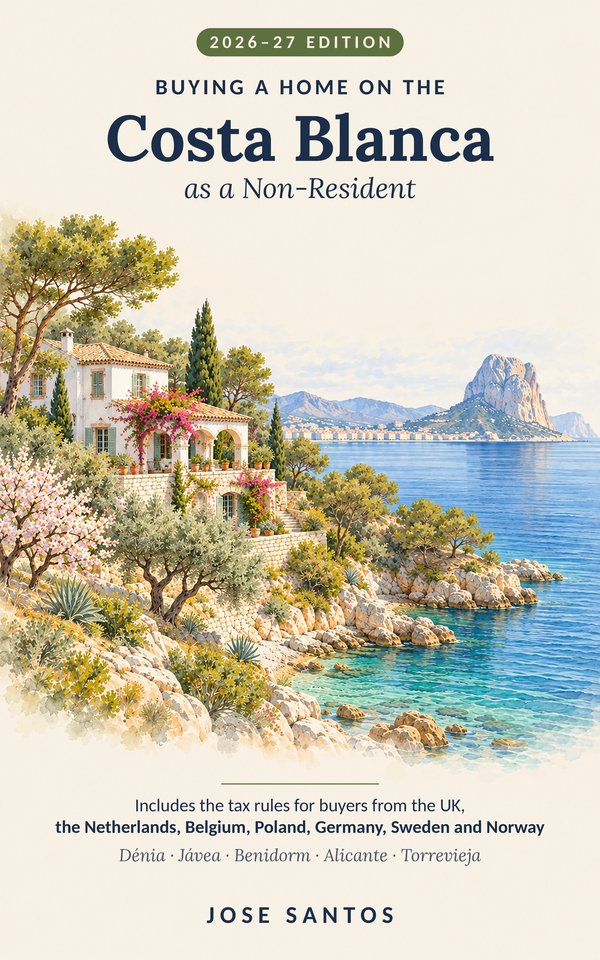
More detail in the book. Chapters 3 and 4 of Buying a Home on the Costa Blanca as a Non-Resident cover this with worked examples, deadlines and the risks behind the figures.
General information based on the rules in force in October 2026, not legal or tax advice. Rules change often: check your own case with an independent Spanish lawyer or tax adviser before you act.
Related: What does a non-resident pay each year on a Costa Blanca home? · Can I let my Costa Blanca home to holidaymakers?