How is a non-resident taxed on selling a Balearic home?
If you live outside Spain and sell your home in the Balearic Islands, Spain taxes your gain at a flat 19%, and the town hall charges a separate tax on the rise in the land's value. Your buyer will hold back 3% of the price as an advance on your tax, and a few months later you file your own return to settle the difference, either paying more or claiming money back.
The rate: 19% on the gain
Non-residents pay 19% on the profit from a sale, whether they live in another EU country or further afield. Unlike rental income, there is no 24% rate on a sale.
How the gain is worked out
Your taxable gain is not simply the sale price minus the purchase price. You start with the price you sell for and take off two things:
- the costs of selling, such as the estate agent's commission;
- what the home cost you, which covers the price you paid, the taxes and fees you paid when you bought, and any improvements you can support with invoices.
An improvement you cannot document does not reduce your gain, so keeping every invoice from the day you buy pays off when you sell.
A worked example
The book takes a home bought in 2015 for €400,000. The owner paid €40,000 in purchase taxes and fees and spent €30,000 on improvements with invoices to show for it. The home sells for €750,000, and selling costs come to €37,500.
| Step | Amount |
|---|---|
| Sale price less selling costs (€750,000 − €37,500) | €712,500 |
| Total cost (€400,000 + €40,000 + €30,000) | €470,000 |
| Gain | €242,500 |
| Tax at 19% | €46,075 |
| Held back by the buyer (3% of €750,000) | €22,500 |
| Balance due with form 210 | €23,575 |
Had the seller been unable to produce the invoices for the €30,000 of improvements, the tax bill would have been €5,700 higher. You can run your own figures through our free calculator.
The 3% the buyer keeps back
Because you are not resident in Spain, the buyer does not pay you the full price. On the day the deed is signed, they retain 3% and must pay it to the Spanish tax agency within one month, using form 211. Ask the buyer or their lawyer for a copy of that form, as you will need it to recover any overpayment.
Form 210 and claiming a refund
Your own return is made on form 210. The deadline is three months after the buyer's one-month period ends, which in practice means about four months after signing.
If the 3% already paid is more than your actual tax, or if you sold at a loss, you ask for the excess to be returned. The tax agency has six months to pay it. If it takes longer, it owes you interest on top. If your tax is higher than the 3%, you pay the rest with the return, as in the example above.
To receive a refund you need your Spanish tax number (NIE) and a bank account, which can be Spanish or foreign.
The municipal plusvalía
The town hall levies its own tax on the increase in the value of the land beneath your home, known as the plusvalía municipal. Since a reform in 2021 you may use whichever of two methods gives the lower figure:
- the objective method, which applies a coefficient, depending on how many years you have owned the home, to the cadastral value of the land;
- the actual gain method, which looks at the real rise in the land's value as shown in your purchase and sale deeds.
If you sell for less than you paid, there is no gain and nothing to pay, but you have to prove it with both deeds.
The tax is the seller's responsibility. However, when the seller is non-resident the town hall can go after the buyer for it, so the buyer's lawyer may ask to retain an estimated sum at completion to cover it. The deadline is 30 working days from the sale. Each town hall sets its own rate, up to a legal maximum.
One point in your favour: the plusvalía you pay is treated as a cost of selling, so it lowers the gain you declare on form 210.
Other things to have ready
- An energy performance certificate, needed before the home can be advertised or sold, and a certificate of habitability (cédula de habitabilidad), required for a sale in the Balearics.
- If a mortgage is outstanding, it is repaid at signing, and cancelling it at the Land Registry has its own notary and registry costs.
- A notarised power of attorney if you cannot attend, so a lawyer can sign for you.
Before you put the home on the market, gather your purchase deed, the tax receipts from when you bought and every improvement invoice. After signing, keep the copy of form 211 safe and put form 210 in your diary for roughly four months later. These rules are as they stand at the time of writing (September 2026).
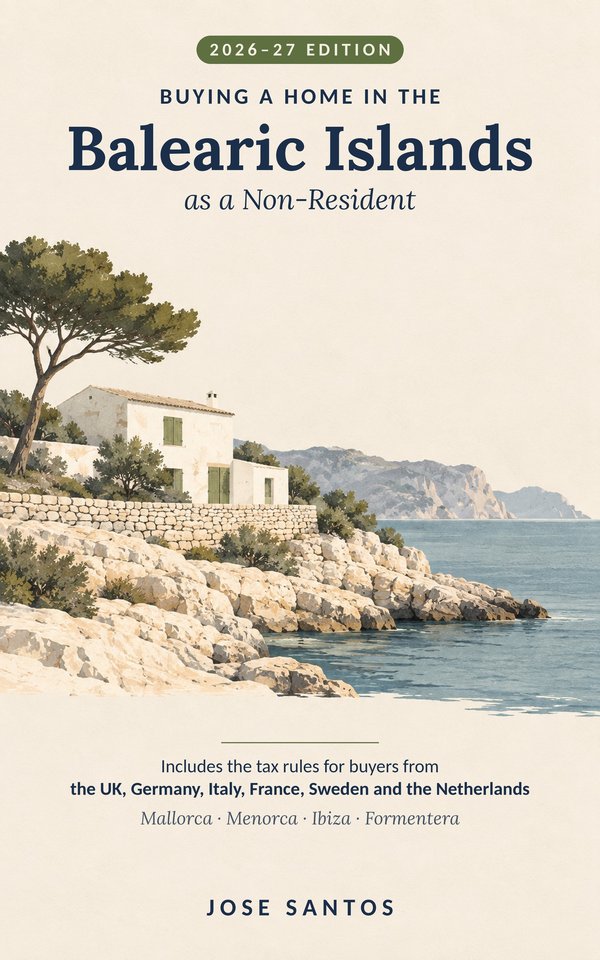
More detail in the book. Chapter 10 of Buying a Home in the Balearic Islands as a Non-Resident cover this with worked examples, deadlines and the risks behind the figures.
General information based on the rules in force in September 2026, not legal or tax advice. Rules change often: check your own case with an independent Spanish lawyer or tax adviser before you act.
Related: Inheritance tax on a Balearic home when heirs live abroad · How much does it cost to buy a home in the Balearic Islands?